
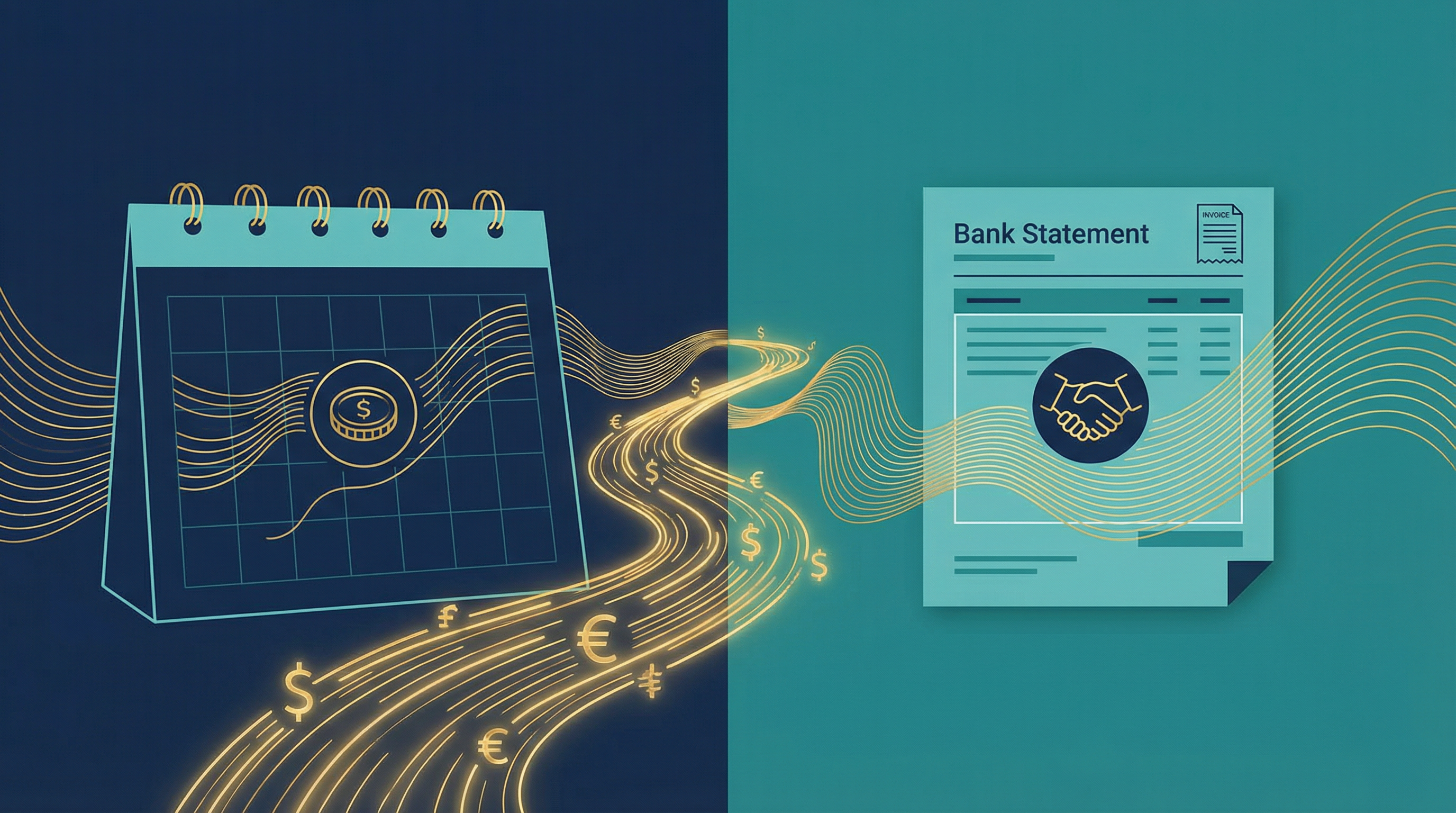
The accounting method you choose affects how you see your business performance. Here's the difference between cash and accrual accounting — and when to switch.
Two Ways to Record Financial Transactions
There are two main methods for recording revenue and expenses in your books. The method you choose has a significant impact on how your financial statements look and how accurately they reflect the true performance of your business.
Most small contractors start with cash accounting. As they grow, many make the switch to accrual. Understanding the difference helps you know where you are and when to make the change.
Cash Accounting
Revenue and expenses are recorded when money actually moves — when cash comes in or goes out of your bank account.
Cash Accounting Example
You complete a job in March but the customer pays in April.
Under cash accounting: the revenue is recorded in April — when the money hits your account.
When Cash Accounting Works
Cash accounting is best for businesses under $300k per year in revenue. It is simpler to maintain, easier to understand, and requires less bookkeeping infrastructure. For a small operation where jobs are short and payments are quick, it can give you a reasonably accurate picture.
Where Cash Accounting Falls Short
As your business grows, cash accounting starts to create distortions. Revenue and costs from the same job may appear in different months. A profitable March can look like a loss if customers pay slowly. A strong April can look inflated if you collected deposits for future work. Cash accounting does not have the nuance needed as you scale.
Accrual Accounting
Revenue and expenses are recorded when the work actually occurs — regardless of when the money moves.
Accrual Accounting Example
You complete a job in March but the customer pays in April.
Under accrual accounting: the revenue is recorded in March — when the work was done.
Your revenue increases in March. Your cash increases in April.
Why Accrual Accounting Is More Accurate
Accrual accounting provides a more accurate view of business performance because revenue and costs are matched to the correct time period. When you complete a job in March, the revenue and the costs associated with that job both appear in March — giving you a true picture of that month's profitability. This is called the matching principle — one of the foundational concepts in accounting.
Key Differences at a Glance
| Feature | Cash Accounting | Accrual Accounting |
|---|---|---|
| Revenue recorded when | Cash received | Work completed |
| Expenses recorded when | Cash paid | Expense incurred |
| Best for | Under $300k/yr | $300k+/yr |
| Complexity | Simple | More detailed |
| Accuracy at scale | Lower | Higher |
| Accounts Receivable | Not tracked | Tracked |
| Accounts Payable | Not tracked | Tracked |
Accounts Receivable and Accounts Payable
One of the major differences between the two methods is how they handle money that is owed to you or that you owe to others.
Accounts Receivable (AR)
Under accrual accounting, when you complete a job but haven't been paid yet, that amount is recorded as accounts receivable — an asset on your balance sheet. You've earned the revenue even though the cash hasn't arrived yet.
Accounts Payable (AP)
When you receive a bill but haven't paid it yet (materials, subcontractors, etc.), that amount is recorded as accounts payable — a liability on your balance sheet. You owe the money even though it hasn't left your account yet. Cash accounting ignores both of these. Accrual accounting tracks them, giving you a much more complete picture of your financial position.
When to Make the Switch
Most businesses should consider switching to accrual accounting when:
- Revenue exceeds $300,000 per year
- You have multiple jobs running simultaneously
- Payment timing varies significantly (deposits, progress billing, net-30 invoices)
- You want to make data-driven decisions about growth, pricing, or hiring
- You are working with a bookkeeper or financial advisor
The Bottom Line
Both methods are legitimate. The right choice depends on your stage of business. What matters most is that you are using some system consistently and reviewing your financial reports regularly. If you are not sure which method your books are currently using, that is a conversation worth having with your bookkeeper. Understanding your accounting method is the foundation for understanding everything else in your financials.