
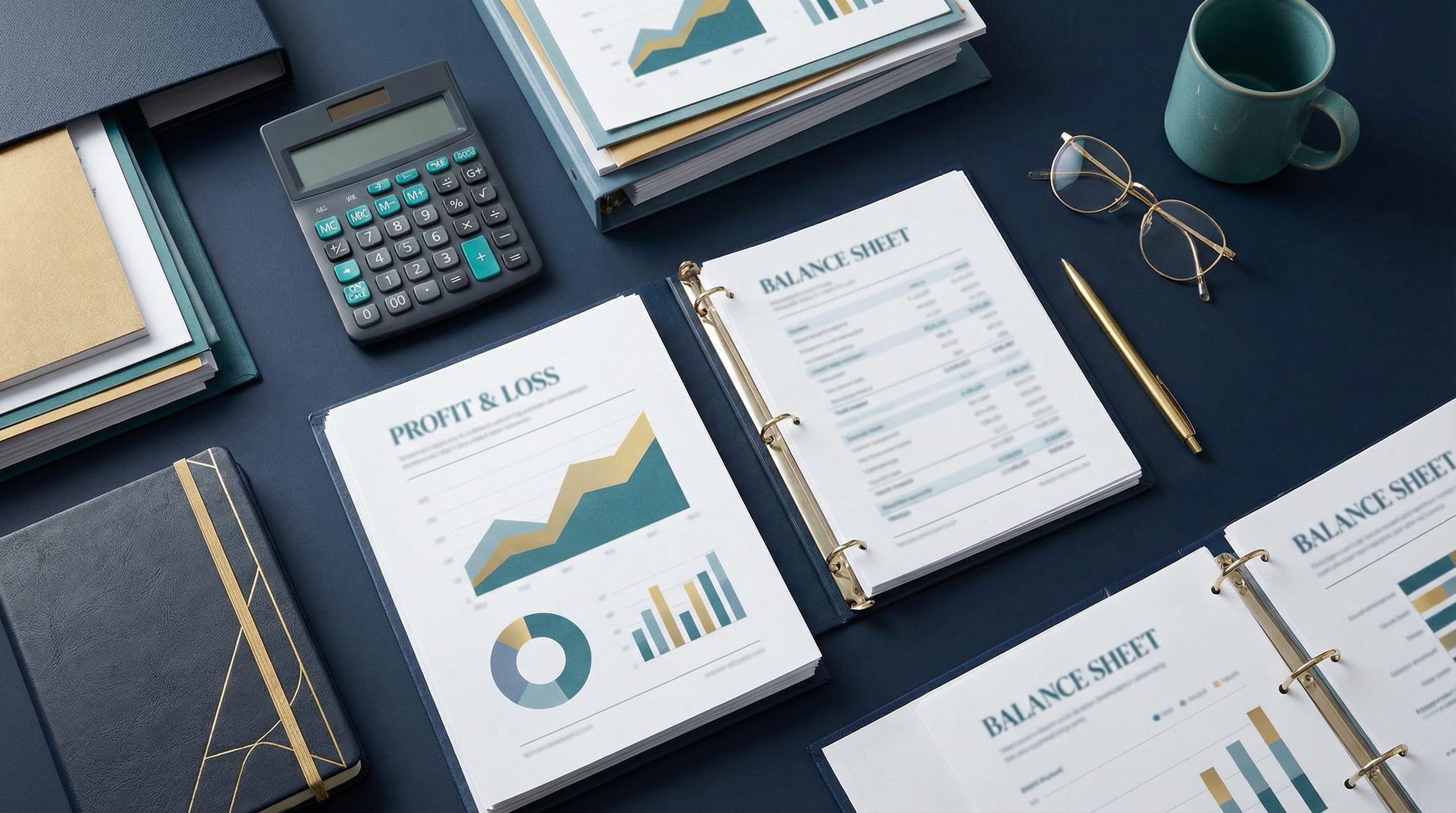
Every business runs on three core financial statements. Most contractors only look at one — or none. Here's what each report tells you and why you need all three.
Every Business Uses Three Core Financial Statements
Each report answers a different question about the business. Most contractors look at their bank balance and assume that tells them everything they need to know. It doesn't. The three financial statements together give you a complete picture of your company's financial health.
Profit & Loss Statement (P&L)
The P&L shows revenue, expenses, and profit. This report measures performance over a period of time — such as a month, quarter, or year. It answers the question: Is the company profitable?
Ideally you are looking at your P&L monthly. This is the most commonly used financial report in a trades business and the one you should get comfortable with first.
Balance Sheet
The balance sheet shows the financial position of the company at a specific point in time.
The Balance Sheet Formula
Assets (what the business owns)
minus
Liabilities (what the business owes)
equals
Owner's (or Shareholders') Equity
It answers the question: What does the company actually own vs. owe right now? Shareholder's Equity is the net difference between assets and liabilities. A growing equity position is a sign of a healthy, strengthening business.
Cash Flow Statement
The cash flow statement tracks the movement of cash in and out of the business. It answers the question: Why did the bank balance increase or decrease?
This is one of the most misunderstood reports in small business. A company can be profitable on paper and still have cash flow problems. This report explains why. It's the bridge between your P&L and your bank account.
How These Statements Work Together
- P&L shows profitability
- Balance Sheet shows financial position
- Cash Flow Statement shows how money moves
All three reports work together to explain what is happening financially inside the company. Looking at only one of these reports often leads to incorrect conclusions.
A Common Trap: Profitable but Broke
A contractor can show $50,000 in profit on their P&L but have $0 in the bank. How? Large receivables not yet collected, upcoming payroll obligations, and customer deposits for future work can all create this gap. The Cash Flow Statement explains it.
Cash vs Accrual Accounting
There are two main ways financial transactions can be recorded, and the method you use affects how all three of these statements look.
Cash Accounting
Revenue and expenses are recorded when money actually moves. Best for businesses under $300k/yr. Simpler, but does not have the nuance needed as you scale.
Accrual Accounting
Revenue and expenses are recorded when the work actually occurs, regardless of when the money moves. Accrual accounting provides a more accurate view of business performance because revenue and costs are matched to the correct time period.
What Successful Financial Management Looks Like
A well-run trades company has clear financial visibility. The owner can quickly answer:
- What was revenue last month?
- What was gross profit on jobs?
- What were the total overhead expenses?
- What was net profit?
- How much cash is available?
Financial reports are reviewed regularly, not just during tax season. Decisions about pricing, hiring, and growth are based on real numbers.
What's Next
In the next modules we will break down the specific financial systems used to run the business, including job costing, Profit & Loss reports, balance sheets, cash flow management, and bookkeeping systems. These reports will give you a clear view of where the business is making money and where it is losing it.